Compiling a picture from the 1901 Census
It’s unfortunate for us that Census records for the era closest to Tom Crean’s birth date aren’t available – both the 1881 and 1891 Censuses, which would have included further information on Tom Crean, were destroyed after a decision was made to pulp them during the First World War.
If they had been available they would convey a sad picture of life for many in a land governed by the Crown and whose population was, in the main, administered by the landlords in 19th century Ireland.
For tenant farmers such as Patrick Crean, Tom’s father, the best barometer we have that presents us with an insight into the living standards of the Crean family, comes in the 1901 Census, compiled 24 years after Tom Crean’s birth.
In 1901, Gortacurraun was a townland collective of nine small single-storey dwellings which housed 70 men, women and children. It’s a figure that would fluctuate as deaths, births and marriages occurred yet it’s safe to state that this figure would have been similar around 1877.
The table below, taken from the 1871 Census, reveals how the number of houses in Gortacurraun had slowly diminished from 1841 to the 1901 figure, leaving half the number of dwellings that were standing 60 years before. The population figure shows a slight resurgence after 1871 but without the two subsequent Censuses made available there’s no means of further analysing the people trend.

So, what does the 1901 Census reveal about Gortacurruan and the Crean house at a time shortly before Tom Crean would make his first trip to Antarctica?
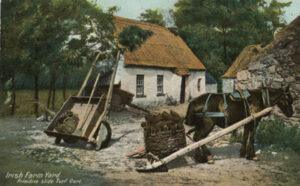
We know from the information listed, that the small single-storey dwelling where 11 children would be born to Tom’s mother Catherine, consisted of three or four rooms in total. We know also that it had a slate or corrugated iron roof. The house had three windows on the front elevation and the walls were most likely constructed from concrete or stone. Living in the house with his parents at the time of the 1901 census, were three of Tom’s brothers, Daniel, Michael and Martin along with his two younger sisters, Johanna and Catherine. His older sister, Mary, it appears, was employed as a servant to the Fitzgerald household on the opposite side of the Dingle peninsula.
The Census also reveals that to keep his animals, house No.2, belonging to Patrick Crean, had a stable for a donkey, a piggery and a cowhouse. All outbuildings for animals will have been of simple construction.
What the Census would have revealed about the living standards a quarter of a century earlier we can only imagine but it’s certain that this 1901 version of the Crean family home will have been an improvement to its 1877 predecessor in which Tom Crean was raised.
The altered fortunes revealed by the 1911 Census
As revealed in my book, Crean: The Extraordinary Life of An Irish Hero, Sir Clements Markham speaking after the return of RRS Discovery, stated that Tom Crean allotted all of his wages to his mother. Tom Crean would secure continual promotions up to the time of his going to Antarctica for the second time in 1910 and the family’s better fortune is reflected by the information given us in the 1911 census. By this time they had clearly extended the dwelling which had an additional two windows. The outbuildings form showed that a dairy and a calf house had also been added.
In this collective of dwellings, each of which was given a number – Hugh Crean, Tom’s eldest brother by 10 years, who had married in 1896, had, by 1901, built his own house which was sited next to the Crean family home.
An interesting fact that takes me completely off track here, is that Hugh’s wedding on February 18th 1896, occurred at the same Annascaul church and and on the same date as that of my grandfather, Timothy D Foley, who married Hanoria Courtney of Coumduff, Annascaul. Courtney happens to be the maiden name of Tom’s mother Catherine. I’ve not yet happened upon evidence of a family connection but who knows? It would be a strange coincidence if confirmed.
By 1911, there remained nine houses with as many families living at Gortacurraun yet the community had diminished to 61 people. Among those lost was Hugh Crean, Tom’s brother, who had passed away after contracting pneumonia in 1908 at just 39 years old.
With the need to improve and modernise living conditions, as would happen with many older cottages across Ireland, the original home where Tom Crean was born was to become a cowhouse before disappearing altogether.
Behind it would remain a structure that would become the two-storey building we see standing at Gortacurraun today (see image below) and we can only guess about its year of construction until further investigation reveals more.
Waiting for the first Census to include Tom Crean’s details.
 Because of the War of Independence, no census was performed in 1921 and the first census undertaken after hostilities were at an end was in 1926, this time under the governance of the Irish Free State.
Although there are growing calls for the 1926 Census to be released for public viewing, it looks increasingly likely that we will have to wait until January 2026 to learn more about our ancestors. It will be the first Census to include Tom Crean’s name and will reveal to us more information about his life after retirement.
If you enjoy my work and research on Tom Crean's story
Please buy me a beer. I can't reciprocate that, unless we meet in person one day, but any donation you make is reinvested to maintaining the Tom Crean platforms I operate and to keeping Tom Crean's name at the forefront.
☕ Buy Me a Beer
