The South Pole Inn: A Complete History
The South Pole Inn in Annascaul has been Tom Crean's most enduring physical legacy for over a century — and its full history holds more genuine mystery, and more recent correction, than I'd ever expected when I first wrote about it.
The South Pole Inn was recently sold and the publicity generated a noticeable spike in interest in its history. I want to be upfront: at the time of writing, I don't know the plans of whoever has taken over the premises.
On July 9th I'm heading over to Kerry, where I have family, and I'll do my best to find out more first-hand rather than relying on rumour. I'll update this section as soon as I know anything concrete — everything below is the accurate, sourced history of the pub from its earliest days to the present.
South Pole Inn — The Early Years
Tom purchased the premises — at the time a single-storey, thatched-roof dwelling — in December 1916, a month after returning to London aboard the Nelson Line's Highland Laddie, having played a primary role in the rescue of his Endurance crewmates following the loss of the ship in the Weddell Sea.
His movements in the months that followed remain somewhat of a mystery, but it's confirmed he departed the armoured cruiser HMS King Alfred at Sierra Leone, West Africa, on 14th February 1917. From there he returned home, and was granted a licence to sell beer, cider, and spirits at the premises — recorded at the time as his "dwelling house."
While continuing his Naval duties, Crean initially left his sister Mary to run the bar. That likely changed after 5th September 1917, when he married Ellen "Nell" Herlihy, who had grown up in her own father's licensed premises in Annascaul, and took her place behind the bar.
Correcting the Record: Who Tom Crean Really Bought From
For years, I believed — and stated in my published biography — that Crean purchased the premises from a man named Webb. A primary-source document I've since uncovered shows that assumption was wrong, and the real story turned out to be more interesting than the one I told.
In an early 1930s boundary dispute heard at court, Crean, by then retired from the Navy, was the plaintiff in a case involving a disagreement with neighbours about land at the front of the South Pole Inn. In his testimony, recorded in a contemporary newspaper cutting, Crean said the following.
Researching Annascaul's census and civic records, I found a Richard Webb, native to the area, who had died in 1912 — four years before Crean's purchase. His son, James Webb, seemed the obvious candidate as the man Crean "knew" in connection with buying the property, and I named him as such in my published account.
The document that corrects this is an original indenture, dated 8th December 1916, between Catherine Curran of Annascaul, spinster, and Thomas Crean. For the sum of £210, Catherine Curran assigned to Crean the dwelling house, garden, and premises, together with the spirit licence attached to it.
This is unambiguous: the South Pole Inn — or rather, the dwelling house and licence that Crean would later rebuild and rename — was assigned to him by Catherine Curran, not by anyone named Webb. There's a yearly rent of £2 reserved in the deed, suggesting this was the assignment of a leasehold interest and licence, rather than a simple freehold sale outright.
Reading Crean's court testimony closely, "I knew a man named Webb" sits in the middle of a passage about a completely different matter — a boundary dispute, decades after the 1916 purchase. There's nothing in his words that ties Webb specifically to the sale itself. It may simply have been a passing remark, with no documented connection to the transaction at all.
Catherine's Story: A Birthright, and a Life Bound for the RIC
The deed initially raised a puzzle of its own. It names the premises as formerly held by John Curran, a US Army pensioner, then by his wife, Kate Curran — who died in July 1916, five months before this document was signed in Crean's name. If Kate had died, how could a deed be assigning property from her in December 1916?
One more piece of this story falls neatly into place. Searching marriage records for 1917, I found Catherine's marriage entry to Cornelius Lucey, a Royal Irish Constabulary officer — recorded in the very same register, on the very same page, directly below Tom Crean's own marriage to Ellen Herlihy. Crean married on 5th September 1917; Catherine married just three days later, on 8th September, at the same Annascaul church.
As an RIC officer, Cornelius Lucey would not have been permitted to serve in his own home community — Constabulary policy of the time required officers to be posted away from their native district, to avoid any conflict of loyalty or favouritism. The couple's first child was born in Macroom, County Cork, in 1918, with two further children born in Limerick in 1919 and 1920, consistent with a constable's postings moving the family around.
The deed predates the marriage by around nine months, so it wasn't the wedding itself that prompted the sale — but a young woman likely already courting, or engaged to, a serving RIC constable would have known a rural Kerry public house had no place in the life ahead of her. Selling the inherited family business to Crean in December 1916, before her own marriage the following September, makes complete sense in that light.
Cornelius Lucey died in Macroom in 1944. Catherine — by then known as Catherine Lucy, widow — lived on for almost three decades more, passing away on 24th February 1972 in Ballymakeera, near Macroom, at the age of 78. It's a quiet, complete life, lived almost entirely away from the Kerry village where her family had once kept a small licenced premises — the same house a young naval officer named Tom Crean would transform into one of the most visited pubs in Ireland.
It's a satisfying resolution, and a good reminder of how often Irish genealogical records of this period reuse the same family names across generations — Kate naming her daughter after herself is exactly the kind of detail that can make a document look contradictory at first glance, until the full family tree is properly traced.
Loss, Doubt, and the 1929 Renovation
After losing his young daughter Kate, shortly before her fourth birthday, in December 1924, it appears the Creans' appetite for running the bar waned. The premises were put up for sale in 1926, though the sale was later withdrawn after a change of heart.
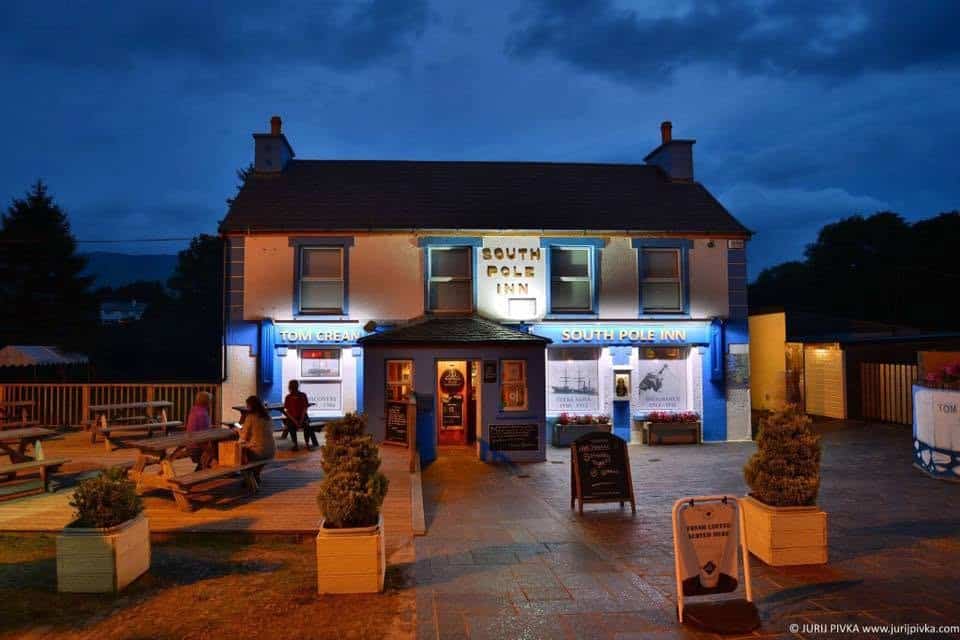
Due to the building's vulnerability to flooding from the nearby river, Crean raised the foundations in 1929 and renovated the building entirely — transforming it from a single-storey cottage into a two-storey building, which he named, for the first time, the South Pole Inn.
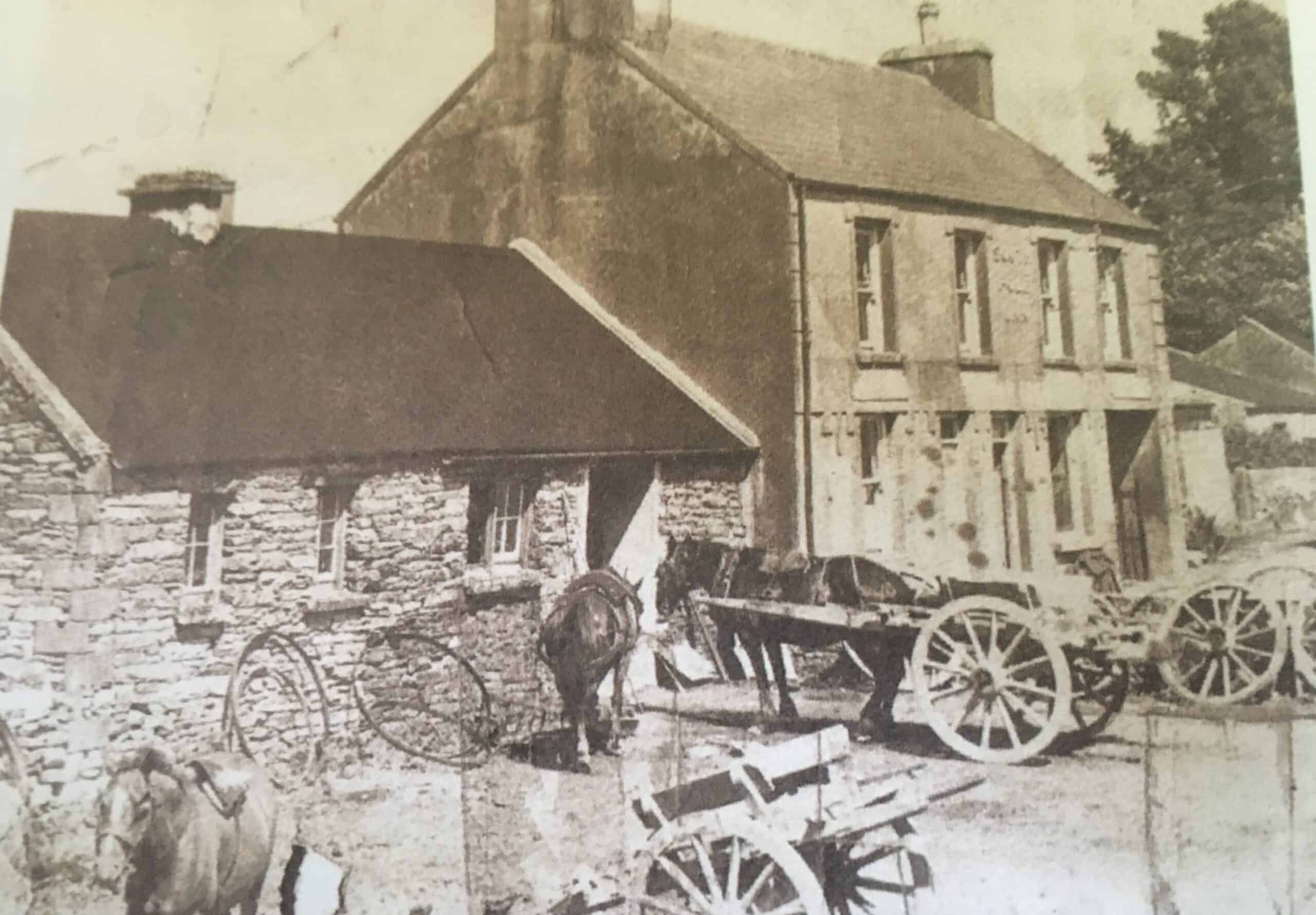
Nearly a century separates that photograph from the image below — the same building, seen on a Kerry night in the 2010s, still carrying the name Tom Crean gave it.
A Changing Cast of Owners
After Tom's death in 1938, the licence passed to his wife Nell. Ten years later, in 1948, it was again put up for sale — curiously listed at the time under the name "Bridge House." A local family, the Cahills, took ownership, before it passed in 1955 to the Lenihan family, who purchased the pub for £1,800.
In 1992, the pub was bought by another Annascaul native, Tom Kennedy, who came from a farming background. He ran it for two years before closing it for a complete renovation, completed in 1994. Kennedy retained ownership from that point on, but having found he "wasn't cut out for working the pub," he leased it out from then onward.
Records of the pub's life between 1994 and 1999 remain elusive. In 1999, Eileen Percival and her family took over the lease, and they remained at the helm of the South Pole Inn until its recent sale.
Eileen Percival's Legacy
Eileen was a huge Tom Crean fan, and a good friend to me. There was no greater supporter of the campaign to officially honour him, and she was the first person I thought of to join me in Dublin in February 2018 — it was Eileen who personally handed over the petition to honour Tom Crean to the Irish government.
Sadly, Eileen passed away in 2020, the year before we reached our goal.
Every owner and tenant the South Pole Inn has had over the decades has understood its historic importance — none more so, perhaps, than Tom Kennedy, whose family connection to Crean ran deeper than most realised.
Whatever plans the new owners have in mind, the South Pole Inn remains the hub of pilgrimage for Tom Crean fans worldwide. I believe the place should retain the authenticity of its era, as it currently does, and I hope it retains the same style and layout, structural issues notwithstanding.
Anything that brings eyes, ears, and feet to Tom's story, and to his birthplace, is a good thing, and will only help grow his fanbase further. My one hope, whoever the new owners turn out to be, is that the most accurate, up-to-date account of Tom Crean's life — one that has uncovered new events, filled gaps, and corrected longstanding inaccuracies — is, once again, made available to visitors at the South Pole Inn, after a decision made a couple of years ago saw it removed from sale there.
If you enjoy my work and research on Tom Crean's story
Please buy me a beer. I can't reciprocate that, unless we meet in person one day, but any donation you make is reinvested to maintaining the Tom Crean platforms I operate and to keeping Tom Crean's name at the forefront.
☕ Buy Me a Beer
