Tom Crean's Lifesaving Solo March
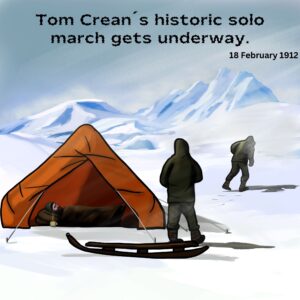
Over a period of 18 hours on the 18th and 19th February 1912, an act of individual heroism that remains unparalleled in the history of Antarctic exploration was playing out its final act during Captain Scott's ill-fated Terra Nova expedition.
Camped on the Polar Plateau, after reaching a distance of 168 miles from the South Pole, Lieutenant Edward Evans, Tom Crean, and William Lashly were ordered by the expedition leader, Captain Scott, to make the long and arduous 700-mile return journey to the expedition hut at Cape Evans.
The sad fate of Scott and the four men he had chosen to accompany him to the Pole would go on to overshadow the drama played out on the return journey of the three who had been denied the prized distinction of becoming the first humans to reach the South Pole. Yet as one tale culminated in tragic loss, a remarkable endeavour would see Tom Crean undertake what has to be considered the finest feat of individual heroism in the entire age of Antarctic exploration.
35 miles from the safety of the expedition hut, Edward Evans had been stricken with scurvy — a deadly disease caused by a lack of vitamin C — and his life was hanging by a thread.
A Man Who Never Thought of Himself
Crean's solo trek of 35 miles in 18 hours to the expedition hut, through the coldest and most inhospitable environment on our planet, without skis, and sustained on a meagre ration of two biscuits and a stick of chocolate, would bring about the safe rescue of the eternally grateful Evans.
Astonishingly, upon staggering through the door of the hut, exhausted and having negotiated his way through fierce Antarctic winds, Crean's immediate thoughts were not for his own recovery — he asked to join the rescue team being assembled to go back out for Evans and Lashly. His request was flatly refused by the expedition's doctor, Edward Atkinson, who recognised what state the man stood before him was truly in.
That selfless instinct was entirely in character. This wasn't the first time Crean had taken it upon himself to perform a daring rescue, nor would it be his last — he had already saved the lives of two other expedition members after they were left stranded on an ice floe during the Terra Nova expedition's earlier stages. William Lashly, who remained behind to nurse Evans, had put in a Herculean effort alongside Crean to drag the sledge bearing their dying colleague in the days before reaching Corner Camp; both men would later be among the rare recipients of the Albert Medal for bravery.
The Moment That Defined Him
Before Crean set off alone, Evans — barely able to stand, and aware of how slim his chances were — ordered the two men to leave him behind and save themselves. They refused. It was Crean, speaking for them both, who gave the answer that would echo for over a century.
It was then that Crean alone struck out for the base station, leaving Lashly to nurse Evans, while he made the 35-mile journey in 18 hours to bring help.
Evans Tells the World
On St Patrick's Day, 1914 — fittingly enough, given the nationality of the man who had saved him — an eternally grateful Edward Evans, by then promoted and addressing a packed audience at New York's Carnegie Hall, told his listeners the full story of the men to whom he owed his life.
"There Should Be an Irishman in Every Expedition"
News of Crean's solo march, and the wider story of his lifesaving exploits, travelled quickly in polar circles. By the time he was a two-time Antarctic veteran, he had earned a reputation that went beyond bravery alone — for his tenacity, his strength, and, just as importantly, his humour in the face of adversity. It made him highly sought after, and it didn't escape the notice of those with ambitions to lead further expeditions south.
Among them was Joseph Foster Stackhouse, a close friend of Captain Scott, whose own proposed expedition was due to depart for Antarctica in August 1914. In January of that year, answering a journalist's question on what makes the best explorer, Stackhouse gave a lengthy reply that, without naming him at first, described Tom Crean to a tee.
Stackhouse then named the man he had been describing all along, singling out Crean's solo march specifically as the standard against which polar courage should be measured.
Coming from a man preparing to lead his own expedition into the same unforgiving terrain, within months of Crean's solo march taking place, Stackhouse's words stand as independent contemporary testimony to exactly the qualities Evans himself would later praise from the Carnegie Hall stage. Two separate men, on two separate continents, arriving at the same conclusion about the character of the Kerryman from Annascaul.
Sadly for Stackhouse, his expedition never did get underway. After he postponed it to a departure scheduled for late in the following year, he was among the victims who perished in the sinking of the Lusitania in May 1915.
If you enjoy my work and research on Tom Crean's story
Please buy me a beer. I can't reciprocate that, unless we meet in person one day, but any donation you make is reinvested to maintaining the Tom Crean platforms I operate and to keeping Tom Crean's name at the forefront.
☕ Buy Me a Beer
