Why Did Tom Crean Join the British Navy? The Truth Behind the Question
- Tom Crean was born on, or shortly before, 16 February 1877 in the townland of Gortacurraun, close to the village of Annascaul, County Kerry, Ireland
- He joined the Royal Navy in 1893 at the age of 16 — 23 years before the Easter Rising
- At the time, the whole of Ireland was under British governance
- Joining the Navy, unlike the Army, was not considered a disgrace in Kerry — confirmed by IRA intelligence officer Tadhg Kennedy in a Bureau of Military History witness statement
- Naval recruits did not swear an oath of allegiance to the Crown
- In April 1920, after retiring from the Navy, Crean stood at a republican protest in Tralee against the maltreatment of Irish prisoners in Mountjoy jail
It's hardly surprising that questions still remain unanswered in the story of Tom Crean. Throughout my research I sidestepped the question of his political leanings — but the evidence that presented itself led me to reach my own conclusions, and this piece is an attempt to share them.
When I first created the campaign to honour Tom Crean back in 2010, I never bargained for some of the vitriolic attacks on his character that first populated the comment boxes. Words such as 'traitor' and phrases like 'taking the king's shilling' were used with contempt. They also displayed a profound lack of knowledge about the era in which families like the Creans — and their neighbours across West Kerry — were living a hand-to-mouth existence, working relentlessly to cover their rents whilst desperately trying to avoid eviction.
Ireland in 1893 — The World Tom Crean Was Born Into
Twenty-three years before the Easter Rising, when Tom Crean made his decision to join the Navy, the whole of Ireland was under the governance of the British Empire. In the environment of deprivation and impoverishment that characterised West Kerry at the time, among the rare opportunities available to young men who wanted to escape poverty and provide for their families, was a pathway into the British Navy.
It is not difficult to understand why youngsters living without hope were captivated by recruitment posters that offered them a way to help their families financially. With the promise of new clothing, food on the table and the luxury of footwear they had only ever seen worn by children of affluent families, the appeal to young boys was simply too opportune to refuse.
Traditionally, the eldest son would inherit the farm, leaving younger siblings without any prospects. Statistically, that left a large number of young teenagers looking to improve their living standards — and the Navy offered a credible route out.
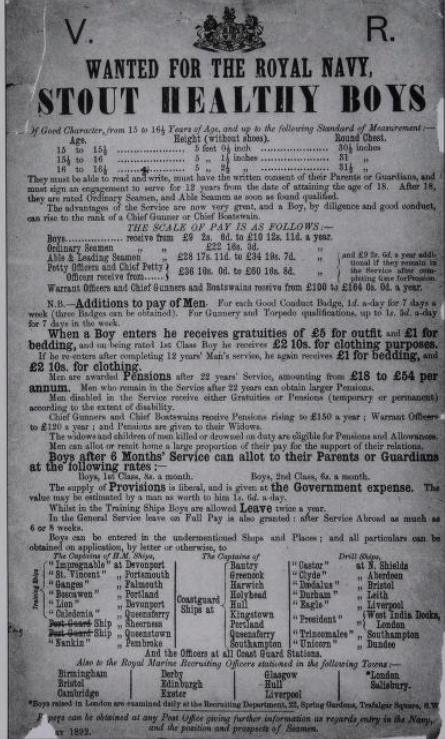
A Royal Navy recruitment poster from 1892 — the year before Tom Crean enlisted
Was Joining the British Navy Considered Unpatriotic in Kerry?
The short answer, supported by primary source evidence, is no — at least not in the way that joining the British Army was.
Joining the Navy had been a longstanding tradition for young Irishmen from the early 19th century, and many boys had trodden this path before Crean. But perhaps the most compelling evidence comes from an unexpected source.
Tadhg Kennedy — who between 1917 and 1921 was the main intelligence officer for the IRA in Kerry, and a close friend to both Michael Collins and Austin Stack — revealed years later, in a witness statement given to the Bureau of Military History, that:
In Kerry, the tolerance shown to boys joining the Navy — in an area that was a hotbed of republicanism — was surprising at first glance. Yet several factors help explain it. Naval recruits, crucially, never had to swear an oath of allegiance to the Crown. Sailors were also far less likely to confront their countrymen and women in the field of conflict than Army recruits were. It is worth noting, however, that republican leaders such as James Connolly and Tom Barry used military skills they had learned in the British Army.
James Kennedy — A Kerry Man Who Blazed the Trail Before Crean
Tadhg Kennedy's uncle, James P. Kennedy, became something of a mentor and confidant to Tom Crean. On 26 August 1912, James was made a Lieutenant — a groundbreaking promotion for a man who had risen through the lower decks. Born close to Annascaul in the townland of Ballynacourty — where Tom Crean himself would later be laid to rest — James Kennedy had joined the Navy in 1878, fifteen years before Crean enlisted. It is possible the two men were related.
Tadhg Kennedy recalled visiting his uncle James in the officers' mess at the Navy's Chatham Dockyard, where he and other Irish officers conversed entirely in Irish. For young men in West Kerry considering their options, the example of James Kennedy was living proof that better fortunes were possible — and that life in the Navy was navigable for an Irishman on his own terms.
The Absurdity of Calling Tom Crean a Traitor
To counter those who still believe that entering the British Navy was an act of unpatriotic treachery, consider what that argument actually requires us to accept: that a 16-year-old, native Irish-speaking, undernourished boy — raised in an empire that discriminated against him, his fellow Irish men and women, and his entire class — was somehow making a conscious political decision to endorse the country whose ships he happened to serve upon.
It is an absurd position. But if it is said, read and repeated enough times, there is a danger it will stick — and in time become accepted as fact by those who have never looked closely at the evidence.
One surprising voice who never bought into that myth was Tadhg Gahan — a member of C Company, II Battalion of the First Dublin Brigade, which occupied the Jacob's Biscuit Factory during Easter Week 1916. After the surrender, Gahan was imprisoned at Frongoch internment camp in Wales alongside 1,800 of his fellow revolutionaries. His account of Tom Crean was positively glowing — the first dedicated account of the heroism displayed across Crean's three expeditions to Antarctica. Notably, on the same day the Easter Rising began, Tom Crean was launching the James Caird lifeboat off Elephant Island — entirely unaware of what was happening in his homeland.
Tom Crean's Republican Sympathies — The Evidence
Tom Crean retired from the Royal Navy in March 1920. In early April 1920 — just weeks later — he stood shoulder to shoulder with his countrymen and women in Tralee at a two-day protest against the maltreatment of 100 republican prisoners being held in Mountjoy jail. Newspaper archives allow us a greater insight of the event. Little more needs to be said about his political sympathies at this time.
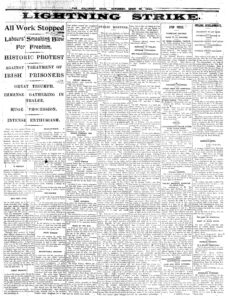
Tom Crean at the Tralee protest, April 1920 — weeks after retiring from the Royal Navy
Shortly after this, the Black and Tans, or Auxiliaries, paid a visit to Crean's premises. Upon discovering that he had served in the British Navy, they called a halt to their raid.
Crean's closest associations tell their own story too. His best friend was Bob Knightly, the Annascaul train station master who acted as an intelligence officer for the Kerry Brigade. Within his trusted circle also, was Patrick O'Neill, the Annascaul dentist and former IRA captain who had been sentenced to five years' penal servitude for his part in the attack on a British military lorry during the Tan War.
The Loss of His Brother Cornelius
Just two weeks after the Tralee protest, Tom Crean suffered a profound personal loss. His brother Cornelius — a Sergeant in the RIC based in Cork — was killed in an IRA ambush, having been identified as a priority target. Tom, along with his brother Daniel and sister Catherine, were among the chief mourners at the funeral on 28 April 1920. The grief of that moment — burying a brother killed by the very movement his friends and neighbours supported — speaks to the impossible complexity of Ireland in 1920, and to the quiet dignity with which Tom Crean navigated it.
Why Crean Stayed Silent About His Past — The Real Reason
It has been suggested that Crean, after retiring home during the Tan War, kept his head down and never referred to his past for fear of reprisals. It is an opinion that has always jarred with what I have learned about the man.
His reticence to speak about his time in the Navy was never born out of fear of the consequences. It was simply an intrinsic part of his character that never allowed him the comfort of being under the spotlight. The same quiet pride that led him to name his pub in Annascaul the South Pole Inn, with barely a word of explanation to anyone.
The Question That Deserved a Better Answer
The years since I first created a campaign to honour Crean have brought a greater understanding of his story, and accusations about his allegiance have dwindled. Yet on the odd occasion they resurface. Recently, an article I wrote that appeared in a news publication was given the title 'Was Tom Crean Ireland's bravest ever hero?'
One of the earliest replies asked: 'What did he ever do for Ireland? He served in the British Navy.'
I removed the comment — but in hindsight I wish I hadn't. What I should have said in reply, and what this piece gives me the opportunity to say now, is this:
Read the Full Story of Tom Crean
Tim Foley's definitive biography — the most thoroughly researched account of Tom Crean's life ever published, including his pre-Antarctic naval career, his expeditions and his life in republican Ireland.
About the Books ↗ Buy on Amazon ↗If you enjoy my work and research on Tom Crean's story
Please buy me a beer. I can't reciprocate that, unless we meet in person one day, but any donation you make is reinvested to maintaining the Tom Crean platforms I operate and to keeping Tom Crean's name at the forefront.
☕ Buy Me a Beer
